

Kalavaahini Trust’s first commissioned work that premiered at its Dance For Dance Festival was ‘Viyoga- Fragments of Light’ by Vaibhav Arekar with choreographic guidance by Malavika Sarukkai, Kalavaahini’s managing trustee and curator of the Festival.
‘Viyoga’ is based on the premise of ‘Loss,’ which Vaibhav split into three — loss of horizontal spaces, loss of authenticity and loss of a need-based society. There were existential questions, not about the philosophical self, but about us as a society going downhill.
Along with five well-conditioned dancers (Eesha Pinglay, Swarada Bhave, Poorva Saraswat, Gautam Marathe and Ann Christy-Pillai), Vaibhav crafted an abstract production with mostly original mood music (Karthik Hebbar) to suit the occasion. He also included Kabir’s verses and Annamacharya’s compositions. The movements and the postures were well-choreographed, the suggestive lighting (Sushant Jadhav) highlighted the spirit of the work, and the voice-overs guided the rasikas well.
The effect was grand and Vaibhav employed different kinds of theatrics to enhance the slick group choreography.

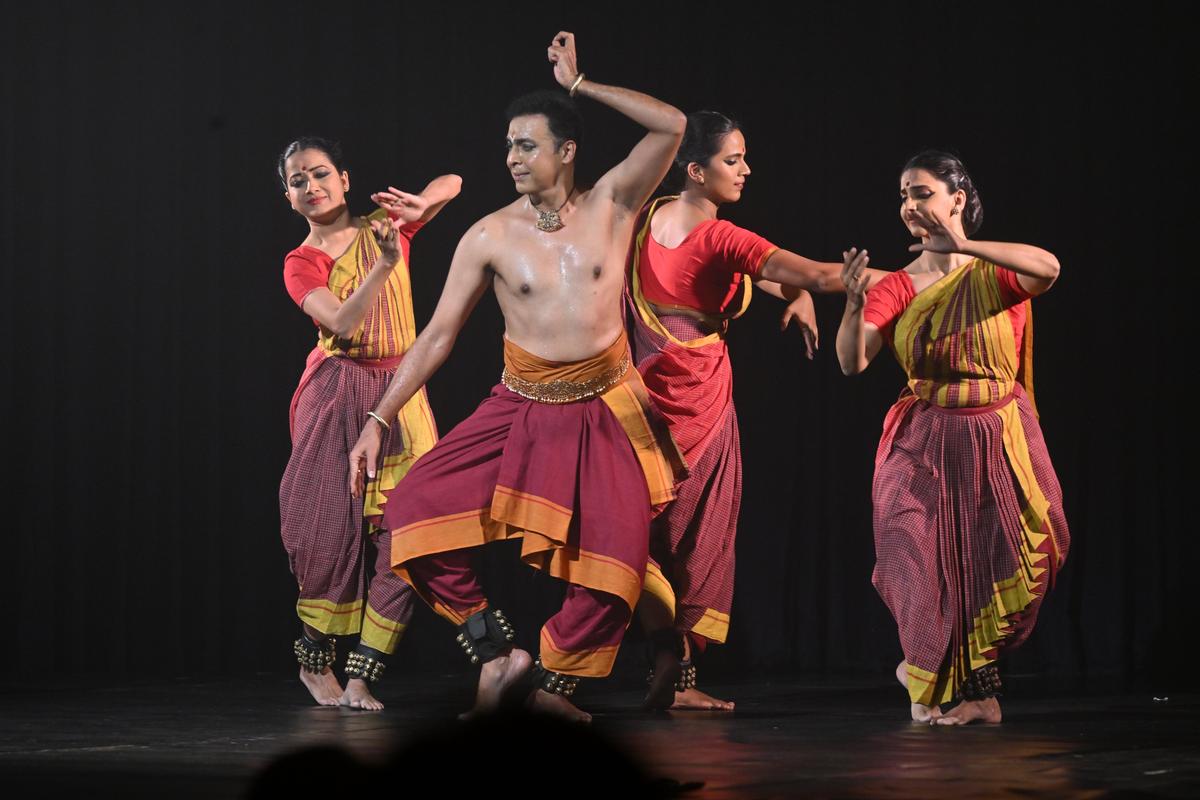
Vaibhav Arekar and dancers of the Sankhya Dance Company.
| Photo Credit:
M. Srinath
The voice-overs featured statements such as ‘The horizontal expanse of my existence has been cramped into a vertical…’; ‘The great trees thinning with the grey concrete’ to indicate urbanisation; ‘Noise outside destroys the silence inside’; ‘Where truth is blurred, envy rules’; and revelling in false perceptions and leading the person inside astray’ for social media-led false images leading to stress and losing the calm within. After a struggle to shut out distractions, Vaibhav finds Shiva. The whole group sways in unison to ‘Sadashivane… Shivam Shivam..’ – this gentle moment was one of the highpoints of the otherwise loud and busy production.
The third segment had some Bengali folk and portrayed some happy times covering the dark effects of commercialisation where you are enticed into buying more than you need. Annamacharya’s ‘Nanati baduku’ spoke of birth and death as a natural part of life. ‘Deh devache mandir’ (Sant Tukaram) brings them back from their state of self-absorption and self-adulation. They finally learn ‘to do the right thing’.
Many factors worked on their own, but ‘Viyoga’ did not work as a whole. It felt repetitive and too clinical. If there was a storyline behind the abstraction, it did not come through.


