

Viswa Kala Pradarshana, presented at Bharatiya Vidya Bhavan, Mylapore, was an Indo–Australian collaborative production that brought together Australian jazz, Carnatic music and Bharatanatyam. Conceptualised by Rajeswari Sainath and Vyshnavie Natya Centre, the evening was shaped as a reflection on unity, equality and shared humanity, drawing from the idea of Vasudeva Kutumbakam: the world as one family.
The stage arrangement mirrored this spirit. Musicians were placed on both the right and left sides of the stage, forming a wide musical frame, while the dancers occupied the centre. This arrangement allowed music and movement to engage constantly.
The opening piece, Vasantha Pravaham, Guru Karaikudi Mani’s landmark composition created in 1985 for the Sruthi Laya Band, set the tone for the evening. Set in Bahudari and Ranjani and structured across multiple talas, the work surged with rhythmic vitality. The choreography responded with clarity, allowing Bharatanatyam’s lines and footwork to flow through changing laya patterns.
Ananda, composed by Suresh Vaidyanathan in Charukesi, offered a softer, introspective contrast. It unfolded through measured movements. A contemporary rhythmic flavour emerged in Dance of New Grand Mom, another composition by Suresh Vaidyanathan, using konnakol entirely as its lyrical base in Sankarabharanam. The work transformed spoken rhythm into playful, grounded movement.
The jazz presence became more pronounced in Pentacle, composed by Adrian S. Western percussion and jazz phrasing introduced a different rhythmic language, which the dancers navigated with ease while retaining Bharatanatyam’s core grammar.

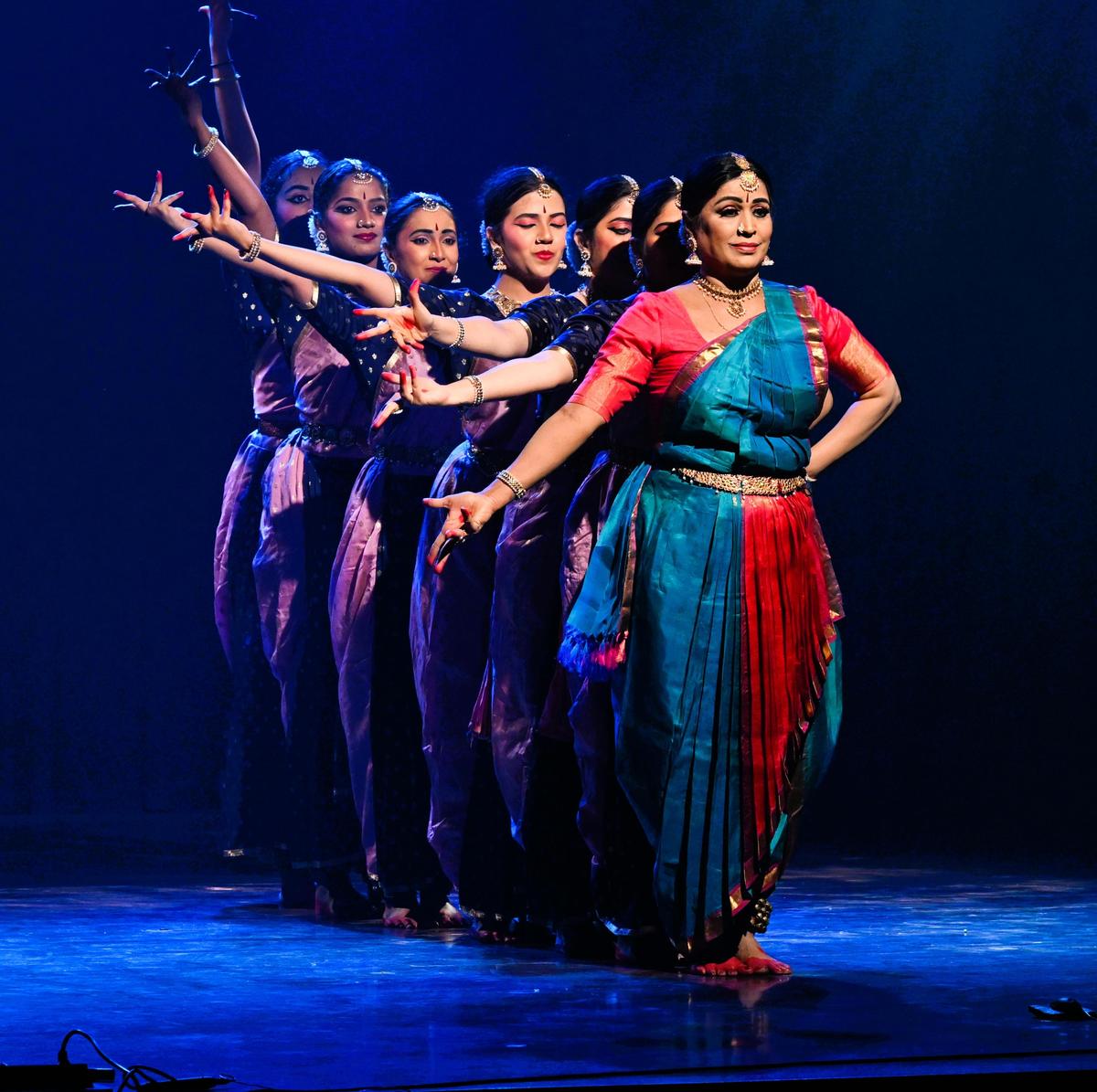
Some of the pieces brought alive memories of mridangam legend Guru Karaikudi Mani.
| Photo Credit:
R Ravindran
A strong rhythmic statement followed in Thani, choreographed to the complex laya patterns of Guru Karaikudi Mani, featuring Tiruvalaputtur Kaliyamurthy. Here, robust percussion met choreographic patterns, with movement shaped to reflect groove as much as structure.
Across the entire production, rhythm reigned supreme highlighting how laya compositions can heighten the impact.
The evening concluded with New Peace, a rare Sanskrit composition affirming the principle of Sri Satya Sai ‘Manava Seva is Madhava Seva,’ with the line ‘Lokha hitham mama karaneeyam’ forming its emotional core.
The dancers of the evening included Rajeswari Sainath, Geetha Gavvala, Sangeetha Gavvala, Meenakshi Murali, Kirthi Shree, Gayathri Yennuni and Nishika Madireddy, while the musicians included B.V. Raghavendra Rao (electric violin), UP Raju (mandolin), Adrian Sherriff (shakuhachi and percussion), Tony Hicks (saxophone, clarinet and flutes), Suresh Vaidyanathan (ghatam and percussion) and Nagai Narayanan (mridangam), together shaping the concept


