

Young Charulatha Chandrasekar’s concert at The Music Academy reaffirmed the promise she has shown over the years. Granddaughter and disciple of veena vidushi and scholar R.S. Jayalakshmi, she has an impressive command over the veena. Charulatha was accompanied by Sarvesh Karthick on the mridangam and Murali Varadharajan on the kanjira.
Beginning the concert brightly with ‘Sogasuga’ in Sriranjani, Charulatha rendered energetic kalpanaswaras. A raga such as Ahiri depends heavily on voice-based inflection and emotional shading. Vocalists can naturally inflect syllables to evoke the pathos in Syama Sastri’s ‘Mayamma’, but on the veena, the musician must simulate this purely through finger technique, making it harder to sustain the raga’s emotional depth without sounding mechanical. Charulatha retained the raga’s austere, inward mood.
Charulatha’s Surutti alapana was marked by poise and steadiness, allowing the raga to unfold without haste. In ‘Sri venkata girisham’, the kalpanaswaras were handled with good control. Rather than relying on speed, the swaras reinforced the raga’s contours, lending cohesion to the kriti and maintaining continuity between the improvised and composed sections.

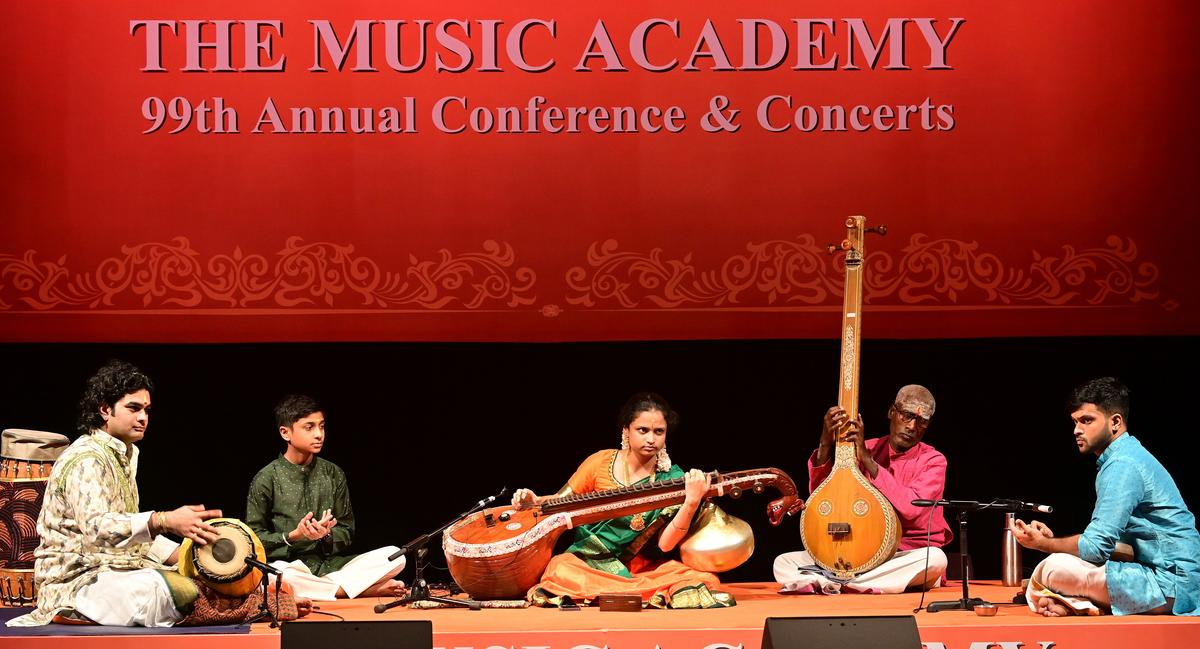
Charulatha Chandrashekar accompanied by Sarvesh Karthick on the mridangam and Murali Varadharjan on the kanjira.
| Photo Credit:
K. Pichumani
Before proceeding to the central Dikshitar kriti, ‘Nee vadane’ in Saranga was presented at an accelerated speed. Charulatha devoted a substantial portion of the concert to the Bhairavi raga alapana and tanam, showcasing a variety of unique prayogas. Her close engagement with the raga was evident in the fluid quality of her improvisation and allowed it to unfold with ease and imagination. The composition presented was ‘Balagopala’. The niraval and kalpanaswaras were appropriately at ‘Neela neerada’.
Throughout the concert, Sarvesh Karthick’s crisp rhythmic articulation and responsiveness underscored the swara passages and niraval sections. His intimate understanding of the compositions enriched the overall musical dialogue. Murali Varadharajan complemented him seamlessly, adding tonal nuance and reinforcing rhythmic interplay. The duo worked well with the veena, balancing energy and subtlety, ensuring its melodic flow remained central, while their percussion enhanced the concert’s texture. The recital concluded with a thillana in Maund.


