
Known for her resonant voice, intricate brigas and melodious sangatis, Sudha Ragunathan reaffirmed her seasoned stagecraft at The Music Academy. Battling a recalcitrant throat, she nevertheless delivered a thoughtfully-curated concert that offered moments of quiet rapture, even if vocal strain occasionally intruded.
She began with Muthiah Bhagavatar’s ‘Mathe malayadhwaja’, in Khamas followed by Mysore Vasudevachars ‘Pranamamyaham sri’ in Gowla. Drawing from the G.N. Balasubramaniam lineage, Sudha shaped the latter with characteristic élan, choosing the line ‘Siddhi vinayakam’ for niraval, precisely placed 22-counts from ‘samam’. Tyagaraja’s ‘Talachi nantane’ in Mukhari unfolded with restraint and poise. A measured Saranga essay preceded Muthuswami Dikshitar’s ‘Priye santatam chintayeham’ in Misra Chapu tala, with Embar Kannan’s violin mirroring the vocalist’s controlled approach.
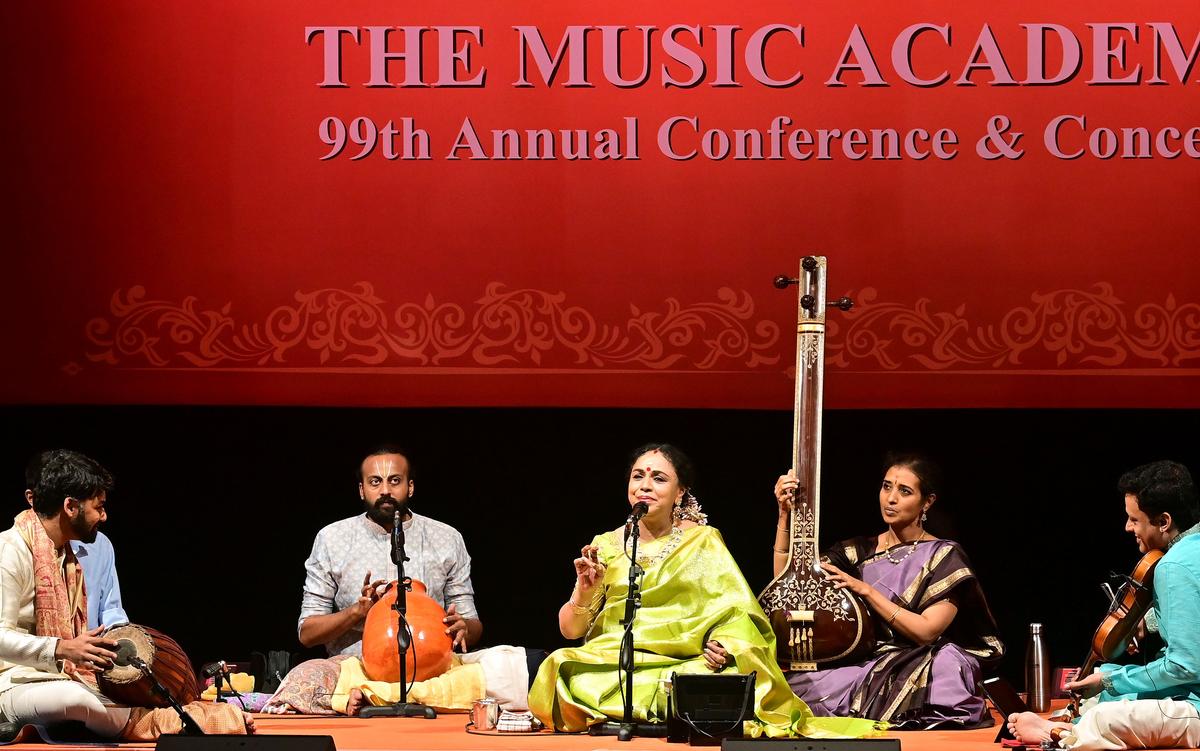
Sudha Ragunathan accompanied by Embar Kannan (violin), Sumesh Narayanan (mridangam) and S. Krishna (ghatam).
| Photo Credit:
K. Pichumani
A brisk turn came with Papanasam Sivan’s ‘Karpaga manohara’ in Malayamarutam, where Sudha’s signature pauses and emphases — especially on ‘Chirapara kabilasa’ — stood out. In keeping with the Academy’s commemoration of Dikshitar’s 250th birth anniversary, the singer chose ‘Sadashivam upasmahe’ in Sankarabharanam as the main piece. The alapana was imaginative, briefly exploring kalyani through graha bhedam, touching Yamuna Kalyani before returning home. Niraval at ‘Purana purusham purantakam’ and later at ‘Sankarabharanam’ was followed by a neat tani avartanam, where the mridangist Sumesh Narayanan and S. Krishnan on the ghatam kept exchanges crisp, culminating in a tisra nadai kuraippu. The hall’s new acoustics made the mridangam’s earlier high pitch noticeable, though it settled during the main piece.
After the lively ‘Kuni kuniyo krishna’, Sudha Ragunathan presented an RTP in Devakriya (Suddha Saveri), set to Misra Jhampa, with the sahityam ‘Sridhara murali’. The rhythmic canvas briefly shifted to Khanda Chapu, and melodic forays into Nalinakanti and Sunadavinodhini added colour. Embar Kannan excelled here, his swift phrases marked by clarity. The concert concluded with the Sai bhajan ‘Man ki aankhen’ and Ambujam Krishna’s ‘Kannanidam eduthu solladi kiliye’, delivered in Sudha’s inimitable sense of repose.
This concert assumed special significance as the vocalist and her accompanists — excluding the ghatam vidwan — represented distinct gurukula lineages of M.L. Vasanthakumari, A. Kanyakumari and Thiruvaarur Bhakthavatsalam, and brought to the stage the cohesion of musicians who have performed together for over several years.

