
Sumathy Mathiazhagan’s lecture in the Music Academy on the sarva vadyam tradition in Thiruvarur, transported the audience to Thiruvarur, evoking images of Thyagaraja’s divine dance and the rituals of the temple. Sumathy said that Parasaivas, the community to which she belongs, have three duties in Thiruvarur- doing puja for Pidari Amman, playing shuddha maddalam and panchamukha vadyam. Her family has the title of Muttukkaarar. Once when the Thyagaraja idol slipped and was about to fall, an ancestor of Sumathy supported the icon with his shoulder, keeping it from falling. He acquired the honorific of muttukaarar (muttu- prop), a title which everyone in the family has had since then.
Muttukaarars play the kudamuzha, so called because the bottom is shaped like a pot (kudam). The pot is made of a special alloy called mani vengalam. Kudamuzha is also known as panchamukha vadyam. It has five faces, each representing one of the five faces of Siva- Isana, Tatpurusha, Aghora, Vamadeva and Satyojata. Deer skin is used as the drumhead, because it gives a gentle sound. Strident beats will not awaken the kundalini. Kundalini is the dormant energy which lies coiled like a serpent at the base of the spine. To show the connection between kundalini awakening, Siva’s dance and the playing of the panchamukha vadyam, the instrument is placed opposite an image of mooladhara Ganapathi portrayed performing a dance. Beside him is the image of a snake. At Ganapathi’s feet, we find two images, one of which is shown playing talam, while the other is portrayed playing shuddha maddalam. The evening puja is the most important in the Thiruvarur temple, and as mantras are recited, the panchamukha vadyam is played.
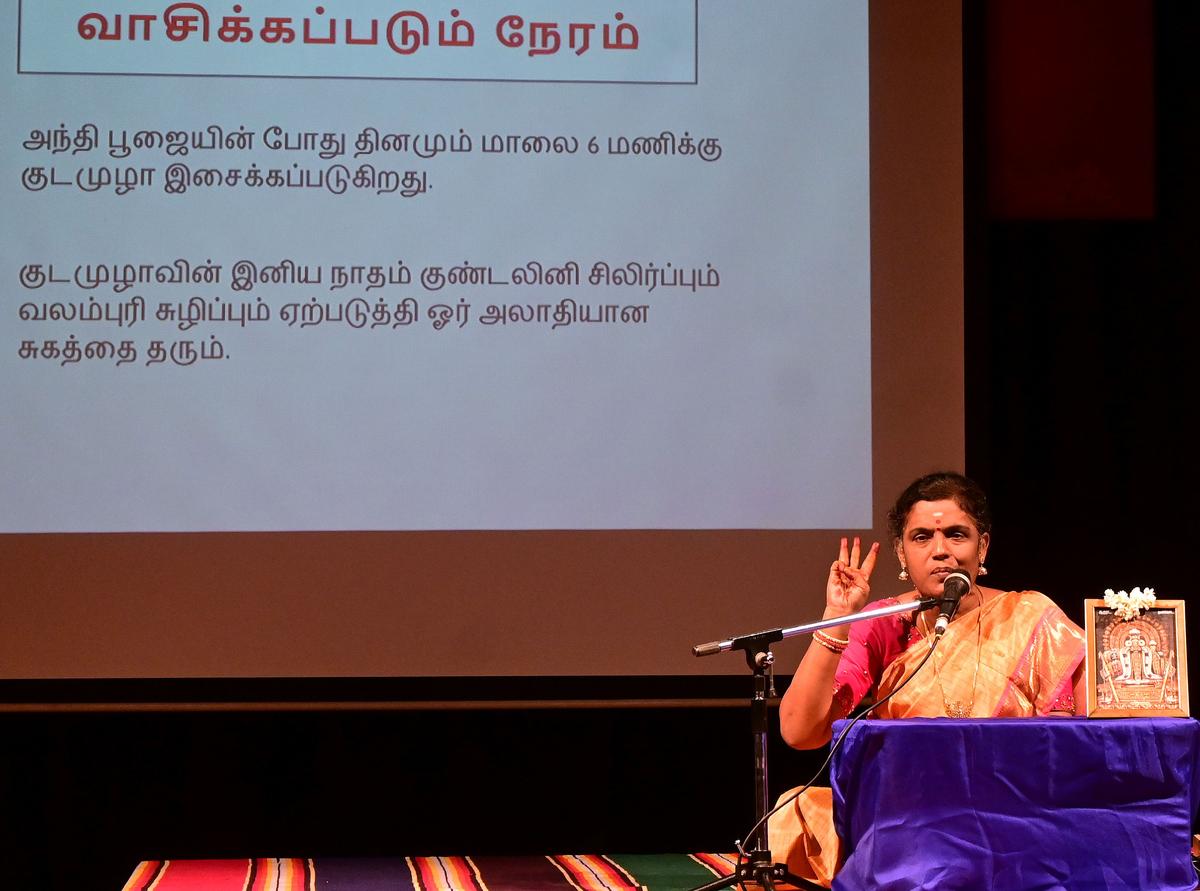
Sumathi Mathiyazhagan.
| Photo Credit:
K. Pichumani
There are nine processions of Thyagaraja, and shuddha maddalam is played for every one of them. Before Thyagaraja is taken on any procession, the idol has to be fixed, to keep it from falling during the ajapa dance. Two silver poles known as pulla thandu are used to secure the idol. There must be utmost concentration when this is being done. So the shuddha maddalam is
played to awaken the kundalini, which will help the men focus on the task at hand. Once the pulla thandu is in place, Thyagaraja begins his ajapa dance, as he moves. This dance, which has the deity gently swaying from side to side, captures the rhythm of breathing. It is believed that the devas come every evening to get Thyagaraja’s blessings. As guests, they have to be seen off with honours. So after the puja is completed, the shuddha maddalam is played along the prahara till the Vallabha Ganapathi sannidhi is reached, as a farewell to the devas. Shuddha maddalam is played during chandanabhisheka too.
Sumathy’s great grandfather was Thambiyappa muttukaarar. His grandfather was also called Thambiyappa muttukaarar, and was a disciple of Muthuswami Dikshitar. Once when Thambiyappa was unwell and could not do his daily duty at the temple, Dikshitar composed the kriti ‘Brihaspate’ (raga Atana), and Thambiyappa was miraculously cured.
While the family tradition of playing shuddha maddalam and panchamukha vadyam continued for generations, there came a time when the family had no male heir, and it seemed as if they would lose their right to play in the temple. However, despite objections from some quarters, Sumathy, who is the headmistress of a school, stepped in. She became the first woman to play shuddha maddalam and panchamukha vadyam in the temple. Her daughter, who studied engineering, decided to follow in her mother’s footsteps. “My grandson Dhruv will also play for Thyagaraja one day,” concluded Sumathy.
Rama Kausalya, member of the Experts Committee, said that Sumathy’s great-grandfather Thambiyappa was once coaxed by his friends to go on a pilgrimage. Evening fell, when they were about to cross the boundary of Tiruvarur. Thambiyappa was reminded of his evening service, and began to cry. He ran back to the temple, calling out Thyagaraja’s name loudly, and did not stop crying till he reached the temple.

