
Ramana Balachandhran has made enough quick strides to evoke a sense of awe, not just with how his veena sounds to the ears, but also with his overall musical intellect. His concert for Parthasarathy Swami Sabha drew a full-house.
The concert was held on Vaikunta Ekadasi, and among the songs chosen was ‘Koluvaiyunnade kothandapani’ in Devagandhari (Tyagaraja). It has a different gait in the charanams, and Ramana found the contours of the tune a plum vehicle to articulate a vibrant opener. ‘Bogindra sayeenam’ by Swati Tirunal (Kuntalavarali, Khanda Chapu) has a similar variety in the charanam that is built on Tisra Nadai.
The Natakapriya alapana was aesthetic, with a large chunk being devoted to delineating its unique structure.The mandarasthayi lucidity was attractive. Ramana’s leaning to raga bhavam ensured mechanical drone was avoided. Ramana elegantly handled Mysore Vasudevacharya’s ‘Idi samayamu’ (Rupakam), including the niraval and swaras, with manodharma sustained during the long piece.
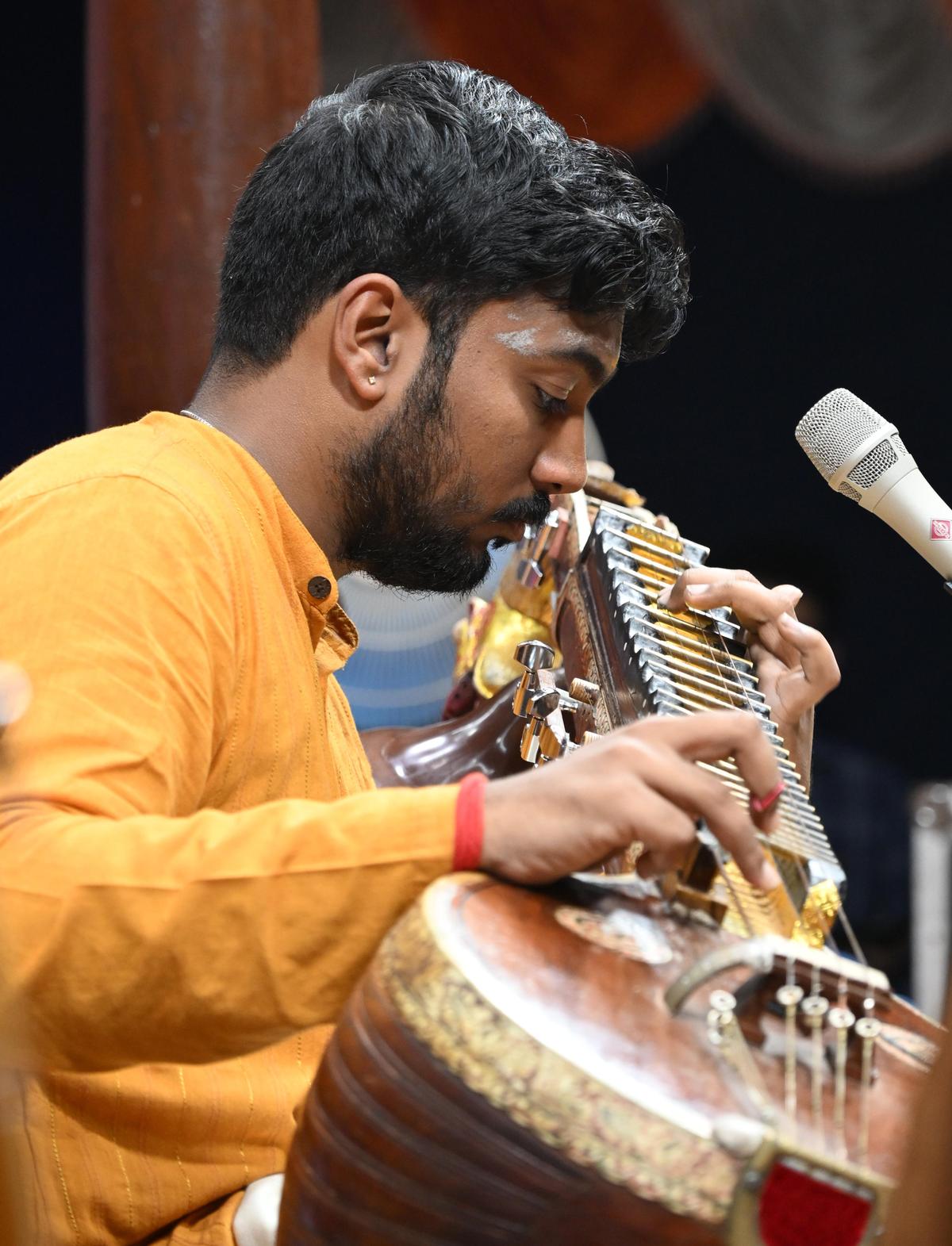
Ramana seamlessly blends notes and strokes in all kalams
| Photo Credit:
B. Jothi Ramalingam
Ramana’s swara kuraippu with some laya exhibition showcased flourishes of the legendary Lalgudi Jayaraman.
The concert had climbed to a buoyant stage when the pensive Brindavana saranga was ushered in. The raga alapana had many emotive resonances. His customised veena aided this. The moves from one octave to another were conjured well to maintain the raga portrait. Tanam was another highlight of Ramana’s effort and alternated with the Hindustani ‘jhala’ style for a few avarthanams. It had an outstanding effect, but Ramana swiftly restored the Carnatic character of the concert in the concluding tanam crescendo. ‘Ranga puravihara enai nee’ in dwi-nadai Adi (40 counts) swept up the audience with a scintillating niraval. Swaras and ragamalika are the icings that normally embellish an instrument concert. The Sahana part in the ragamalika was a beauty.
It is often assumed that ‘mel kalam’ is a no-brainer ploy for audience appreciation. Sai Giridhar is a competent mridangist but his non-stop top speed playing was not quite in sync with Ramana’s expressions. K.V. Gopalakrishnan on the kanjira did slip in good touches, especially in the niraval and swara passages. A Madhuvanti tail piece and the popular ‘Payoji maine ram ratan’ enveloped in warm Pahadi notes kept up the intensity even at the closing moments of the concert.
Ramana occasionally sang the lines of the kritis, with a pleasing delivery. His nonchalance and the ability to seamlessly blend notes and strokes in all kalams is obviously a gift. One hopes he continues to stay true to the classical high ground.

