
Dry waste continues to pile up at the Erode Corporation’s compost yard at Vendipalayam, forcing residents to press for the processing and clearance of the waste.
As per the 2011 Census, the city has a population of 4.98 lakh and an area of 109.52 sq. km, divided into 60 wards across four zones. It comprises 1,69,912 residential properties and 27,386 commercial establishments. The city generates nearly 180 to 220 tonnes of waste daily, including about 60 tonnes of biodegradable waste and 140 to 150 tonnes of non-biodegradable waste, all of which is collected by conservancy workers.
Biodegradable waste is converted into compost at 25 micro-composting centres, and the manure is supplied free to farmers. Recyclable waste is sold by conservancy workers, while non-recyclable waste such as metals and electronic items is transported to incineration plants at Vairapalayam. The remaining 60 to 70 tonnes of dry waste are disposed of at the Vendipalayam compost yard every day.
Earlier, around 4.45 lakh cubic metres of garbage accumulated at the yard were bio-mined, and the exercise was completed in 2021. Since then, dry waste has been continuously dumped at the site, with the total accumulation estimated to have exceeded 1.75 lakh tonnes. However, officials said precise data on the quantity was not available.
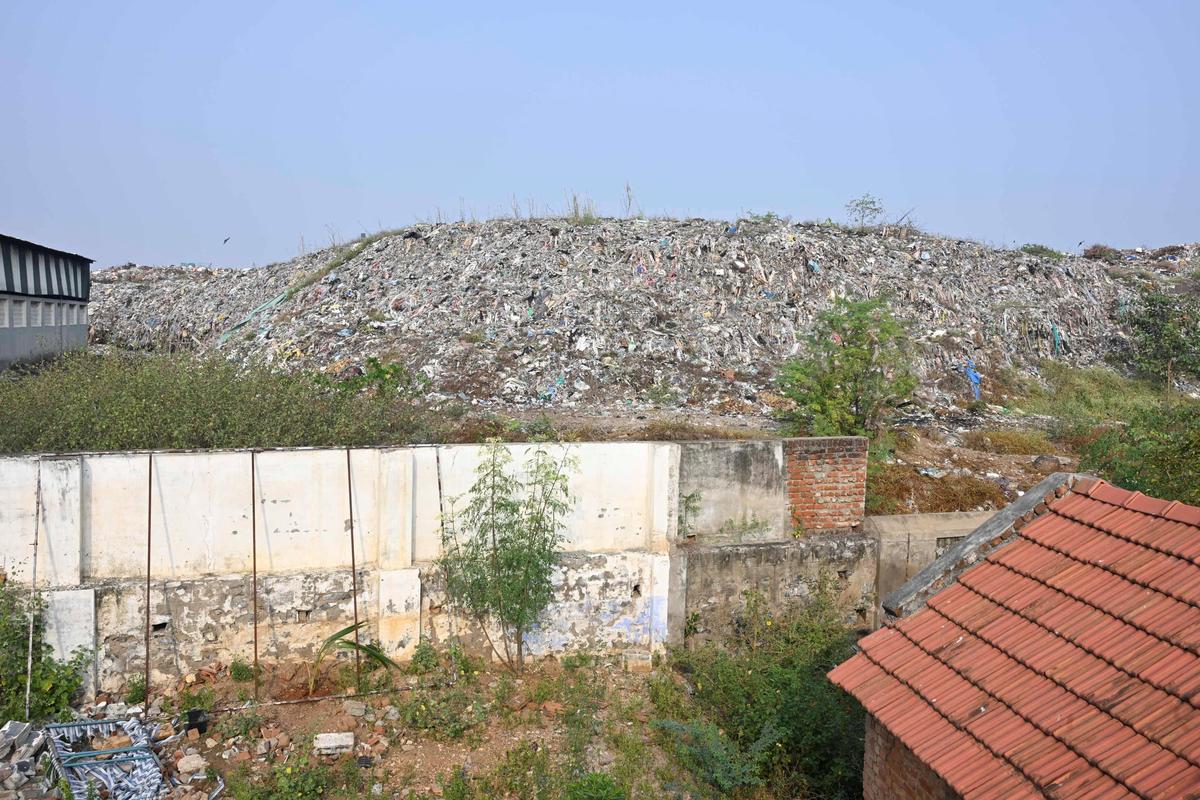
The city generates nearly 180 to 220 tonnes of waste daily, including about 60 tonnes of biodegradable waste and 140 to 150 tonnes of non-biodegradable waste
| Photo Credit:
M. Govarthan
Residents said the steady build-up of dry waste had heightened the risk of fire outbreaks, especially during summer, and urged the Corporation to ensure its prompt processing and removal. “Waste that had been dumped for over 60 years was earlier processed and cleared. The same approach should be adopted now,” said P. Murugan, a resident.
Corporation officials, however, said that bio-mining could be carried out only for legacy waste that had accumulated for more than seven years.
City Health Officer M. Karthikeyan told The Hindu that the civic body was considering setting up a material recovery facility (MRF) or a biogas plant to utilise the dry waste. He said a proposal would be sent to the State government shortly.

