
Meera Balasubramanian’s Bharatanatyam recital, at Brahma Gana Sabha, unfolded as a meditative and emotive journey, where content and individual interpretative choices converged to create a performance marked by quiet intensity rather than overt spectacle. What stood out across the evening was her ability to let movement breathe and allow stillness, pauses and transitions to speak as eloquently as expansive nritta passages.
The recital opened with an excerpt from ‘Soundarya Lahari’ of Adi Shankaracharya, set to music by Lavanya Balachandran. Rather than presenting the hymn as a literal narrative, Meera approached it as an inward exploration of Shakti. Particularly striking were her glances — measured, layered and purposeful, and mirroring the poet’s evocation of the Goddess’ drishti towards creation, divinity and the devotee.
The centrepiece of the recital, the varnam ‘Senthil nagar mevum’ in raga Nilambari and Adi tala was composed by Lalgudi G. Jayaraman and choreographed by Vikas Parayalil. Meera impressed with her unhurried sancharis. Her portrayal of Muruga balanced strength and tenderness. The jatis were executed with clarity and poise, but it was her sustained emotional continuity that held attention. The transitions between nritta and abhinaya were seamless.
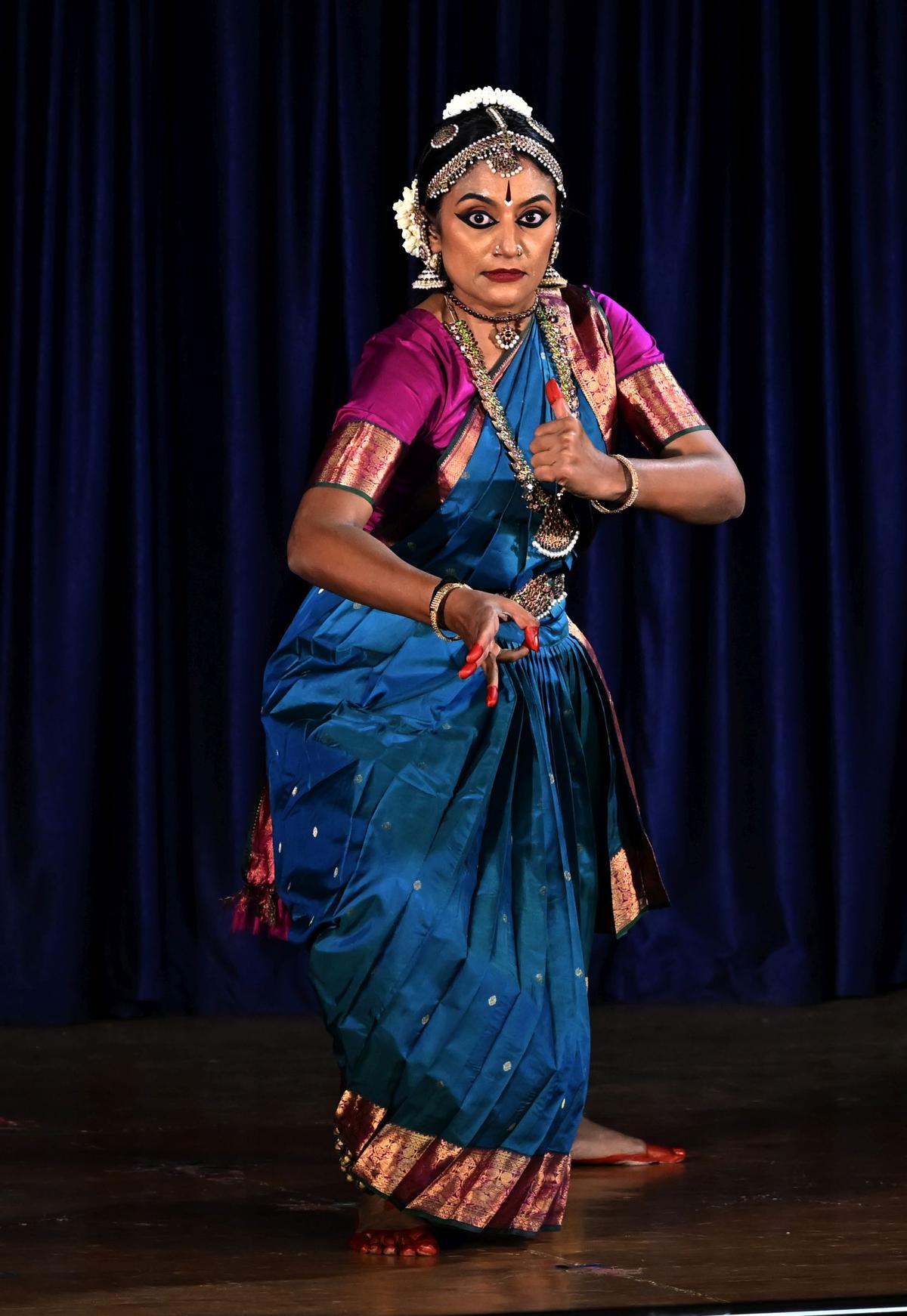
Meera Balasubramanian’s transitions between nritta and abhinaya were seamless.
| Photo Credit:
Akhila Easwaran
In the javali ‘Muttavadura’ in raga Saveri and Adi tala, composed by Thanjavur Chinnayya Pillai, Meera shifted gears effectively. Here, her abhinaya was sharp. The nayika’s resentment found expression in tightly controlled gestures, fleeting side glances, and a body language that oscillated between indignation and vulnerability. The line “do not touch me” was not overstated; instead, it emerged through a deliberate withdrawal of space, underscoring emotional distance more than physical rejection.
The concluding thillana in raga Desh and Adi tala, composed by K.N. Dhandayudapani Pillai and choreographed by Vikas, was marked by buoyancy and rhythmic assurance. Dedicated to Lord Natesha, the lord of dance, the piece sparkled with crisp footwork and clean lines, while retaining an undercurrent of devotion.
The orchestra contributed significantly to the evening, with Vikas on nattuvangam, Sushanth Parambath on vocals, T.V. Sukanya on the violin and Siva Prasad on the mridangam.

