
On December 10, 2025, Mallappa, a farmer, was attacked by a tiger in Kundakere village in Karnataka’s Chamarajanagar district while tending to his cattle in the fields. Chaos erupted in Bandipur on December 27, when forest watcher Sanna Haida was killed by a tiger, becoming the fourth person after three farmers, to succumb to animal attacks in the Bandipur tiger reserve (BRT) area.
Rise in man-animal conflict
Karnataka’s tiger problem today stems less from the species’ survival and more from challenges created by its conservation success. With a rise in tiger populations across reserves such as Nagarahole, Bandipur, Bhadra, Kali and BRT, the State is witnessing intensified man-animal conflict.
These conflicts account for nearly 60% of all human deaths linked to wildlife encounters in Mysuru, Chamarajanagar, Kodagu and Hassan over the last four years. According to Forest Minister Eshwar Khandre, as many as 203 people have died in man-animal conflicts in Karnataka between 2022 and 2025. These statistics highlight the impact on populations inhabiting the forest fringes of southern Karnataka, where human settlements increasingly overlap with wildlife habitats.
Recent incidents bring to mind Huli Banthu Huli, a 91-minute feature film, produced by Malnad Movie Makers in 1975 and released in 1977. Directed by C Chandrashekar, the film was screened at the International Film Festival of India 1978 in the Indian Panorama section and received the Critics Award.
Exploring the historic conflict between man and tiger, Huli Banthu Huli continues to resonate today. It marked Chandrashekar’s directorial debut and earned him the prefix of ‘Huli’ (tiger). Filmed in the backwaters of Khanapur, HD Kote and Kabini, Huli Banthu Huli tells of a man-eating tiger terrorising tribal communities and the efforts to capture it.
Director C Chandrashekar.
| Photo Credit:
SPECIAL ARRANGEMENT
It featured National Award winner MV Vasudeva Rao of Chomana Dudifame as a tribal leader and actor N Ramakrishna as a forest department official as well as residents of the filming location. Chandrashekar incorporated authentic tribal songs performed by locals for the soundtrack.
Chandrashekar, speaking from his home in Hanumanthanagar in Bengaluru, elaborated on his motivation to make Huli Banthu Huli. “While I was studying the problems faced by tribal communities in the Khanapur forest range, a tiger attacked a tribal woman; this incident motivated me to make a feature film on the plight of those living near forest ranges.”
After writing the script, Chandrashekar says, he was looking for a suitable dialogue writer. “Kikkeri Narayana’s name kept popping up. Kikkeri was an expert in tribal studies and a writer and agreed to write the dialogues in the tribal dialect.”
He adds how his friend, producer Pattabhirama Reddy, helped in the making of the film, camping with him the forest. “UR Ananthamurthy did the ceremonial clap for the inaugural shot and though I wanted Rajinikanth to play an important role in the film, my team did not approve of this idea and opted for Ramakrishna instead.”
ALSO READ: Wild and safe: On growing human-wildlife conflict
Dramatic start
“It was a herculean task to find a tiger which would follow its handler’s instructions. A friend in the Tamil film industry, who worked with Sandow MMA Chinnappa Devar known for his films featuring animals, promised to get a tiger from a circus in Dindigul. The circus owner demanded ₹10,000 and sent 10 people with Jyothi, a tigress, in a cage.”
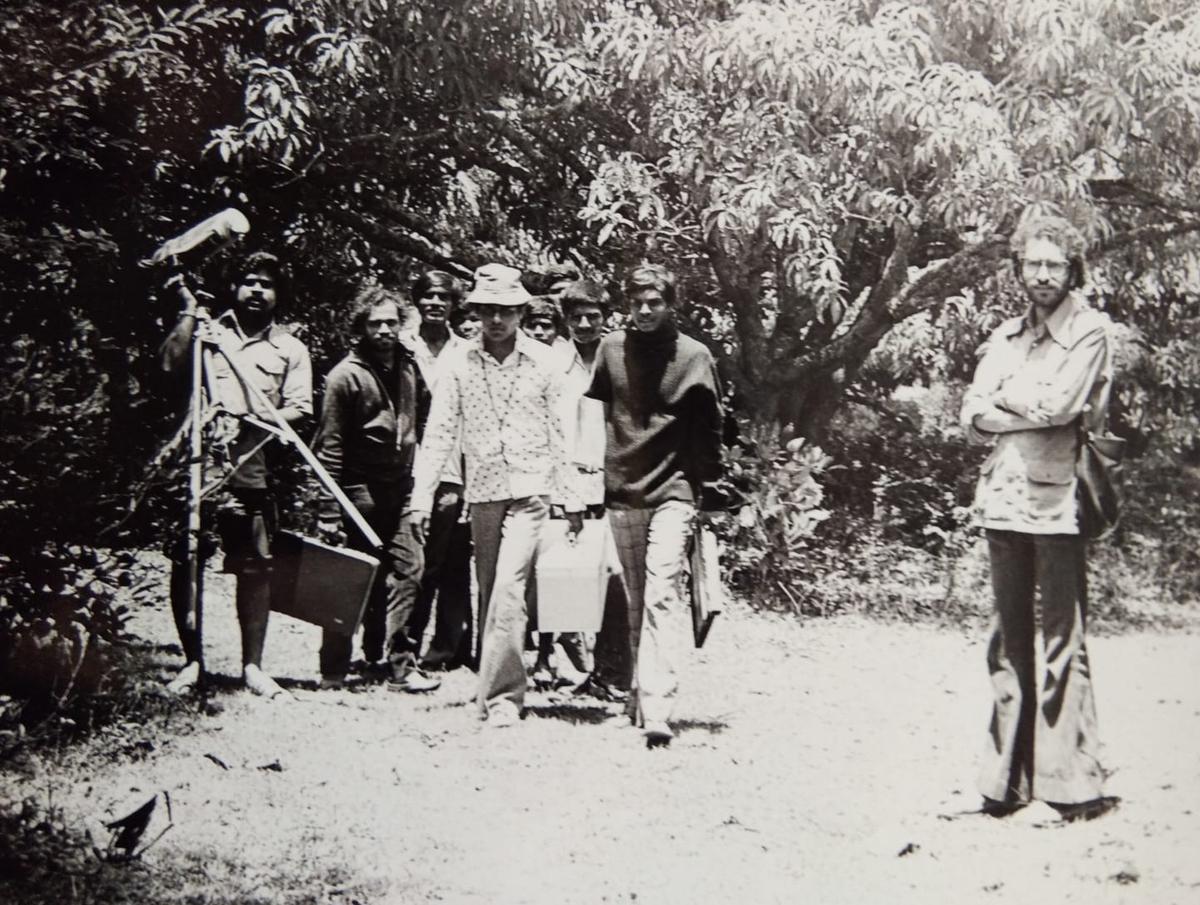
The crew members of during the filming ‘Huli Banthu Huli’.
| Photo Credit:
SPECIAL ARRANGEMENT
Filming was scheduled to begin at Khanapura village on the banks of the Kabini, at 4 pm, beginning with the scene where a hunter shoots a tiger from atop a tree. However, the sudden, unfamiliar noise startled Jyothi and she darted into the meadows. All attempts to trace her failed and even the announcement of a reward was not enough of an incentive to tempt the locals who feared being attacked.
”Days later, Korangu James, a member of our team noticed a tired tiger under a tree. After Jyothi responded to her name, the team captured her and she was treated by the forest veterinary doctor. After she was refreshed, shooting commenced with precautionary measures.”
Chandrashekar adds how news of the missing tiger had reached Bengaluru with every newspaper carrying an article on the incident. “Due to this incident, our 20-day shooting schedule stretched to 30, incurring additional expenditure. Thankfully, since we found the tigress we didn’t have to compensate the circus owner.”
Tragic end
Huli Banthu Huli was screened at the Panorama section of the International Film Festival of India 1978, and received the Critics Award. Yet, despite winning accolades, the film vanished without a trace.
“I didn’t have the facility to store negatives at home, so I sent the print to Doordarshan. It was screened once during prime time, with other award-winning films. After that, all attempts to get the print back from Doordarshan have failed. Even now, I don’t know where it is. This is the fate of most celluloid film in our country.

