
Coastal erosion is not only taking a toll on India’s shoreline but also on the communities that made their homes by the sea. Resettlement may provide safety from the waves, but replacing lost livelihoods becomes an uphill task, as some climate refugees in Odisha are finding outKrushna Chandra Behera has no illusions about life after relocation. As the sea moved into his village in Odisha, residents were moved out to resettlement colonies. But safety came at a price, says the man in his eighties. “Though some people have fertile land there, who will travel 12km daily to carry on farming after crossing the Bhitarkanika mangrove forest and a crocodile-infested river?” he asks.Behara used to be a resident of Satabhaya village in Odisha’s Kendrapara district. It was back in 1992 that the state govt decided to shift its residents away from its disappearing shores. Bagapatia, the spot identified for the resettlement colony, lay 12km inland. But the relocation proved to be slow going.
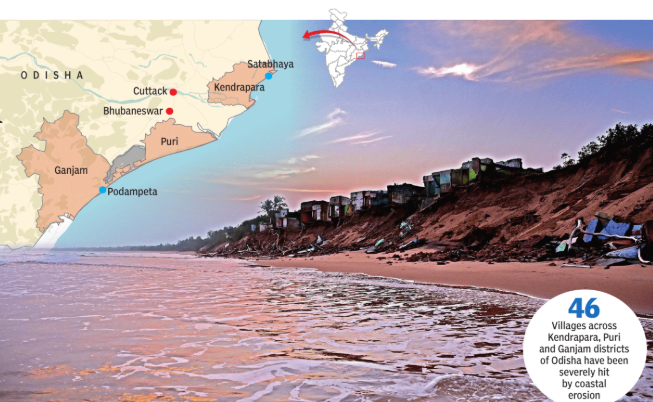
The foundation stone for the colony was laid only in 2004 and the initial batch of 571 settlers moved there in 2017-18. In April 2018, the deities of Panchubarahi temple, which are worshipped by Dalit women priestesses, were shifted with much fanfare and religious fervour to a new temple constructed at Bagapatia.The state govt claims that the Bagapatia resettlement colony is the first of its kind in the country for victims of climate change and coastal erosion. But there’s much that remains for its residents to work out, livelihood being the most pressing of the issues.Paused LivelihoodsThe dilemma of choosing a secure place to live and losing the means of earning a living defies easy solutions. Just ask Ashok Pradhan, one of Behera’s neighbours at the Bagapatia resettlement colony. “Govt gave us land to build houses, not to farm. The sea is too far for fishing. How do we earn?”“We were self-sufficient before. Now, we are daily-wagers and migrant labourers. Except elderly people, children, and women, most of the displaced people of Satabhaya are going to other states in search of jobs. We are staying like refugees here,” said Debendra Rout, 43. Farming, fishing, and rearing domestic animals, economic activities of the past are no longer options for the Bagapatia settlers.Be it Satabhaya and its neighbouring villages in Bhitarkanika National Park or Podampeta village in Ganjam, the story is the same.“We lost our houses, fish-drying ground, and livelihood. We left the village with a heavy heart. We are staying like refugees here for no fault of ours,” said Ch Shyama, ward member of Podampeta village in Ganjam district. As seawaters threatened their homes, 463 families from the village were moved to two separate locations — Podagada (in 2011-12) and Mayurpada (in 2015-16).Those left behind face much the same issues. “I do not know when my hut will be washed away by the sea. As I do not have any other option, I am staying here with my sick wife and 2 sons,” says Jagabandhu Behera, whose family continues to stay at the nowabandoned Satabhaya village.“My 13-year-old younger son dropped out after his school was shifted to Bagapatia. There is no motorable road to reach Bagapatia from my place if any health emergency occurs. Let’s see when the govt will relocate my family,” said Jagabandhu.In Ganjam district, L Bhogiraju of Rameyapatna, a village close to the Andhra Pradesh border, said that “though some villagers got rehabilitated at a nearby village, they could not adjust there due to a lack of livelihood options”.“We need to stay near the beach for fishing activities. That’s why many people are staying in this village only. We have been requesting the govt to protect the village and livelihood of the fishermen here,” said Bhogiraju, who’s also district president of Traditional Fish Workers Union.As the sea keeps moving inside, these stories drive home the challenge of adapting to a changing environment for those living on the coast. It’s a crisis that threatens to cut a widening arc.Invading SeaIn Dec last year, the minister for environment in Odisha govt, Ganesh Ram Singkhuntia, told the state assembly that 46 villages across three districts — Kendrapara, Puri and Ganjam — have been severely affected by coastal erosion.Unlike India’s western shoreline, the eastern seaboard is particularly vulnerable to invasion by the sea. Erosion hotspots have sprung up in states like Odisha and West Bengal and appear poised to drastically alter the map and the lives of people living in these areas. At stake are villages, infrastructure and once-thriving ecosystems.According to a 2022 report by the Chennai-based National Centre for Coastal Research (NCCR), a third of India’s 7,000km mainland coastline is facing the threat of erosion. Of the 3,144km that make up the east coast, around 1,205km is under siege from the forces of nature.Odisha has faced a sustained attack from the hungry waves. Between 1990 and 2018, over 140km — about 25% — of Odisha’s 549km coastline experienced erosion, says NCCR. In neighbouring West Bengal, over 60% of the coastline is facing erosion. At least 15 locations along the Digha-Sankarpur stretch and parts of the Sundarbans are among the worst affected.“Satellite data shows erosion is advancing rapidly south of Digha. In some places, particularly in Bangladesh and West Bengal, land is already submerging. The Sundarbans, too, are under threat, and the loss of mangroves is worsening the situation. Climate change and rising sea levels are among several potential causes of shoreline changes,” said Sourav Sil, associate professor at IIT Bhubaneswar’s School of Earth, Ocean and Climate Sciences.Further south, the NCCR report notes a similar trend. Tamil Nadu has 43% of its coastline eroding, while in Andhra Pradesh it’s 29%. In Puducherry, over half of its coastline (56%) shows signs of erosion.Shifting SandsR S Kankara, director of NCCR, said while coastal erosion is a natural phenomenon, human actions can worsen its impact. “Sediment movement (transport of sand and mud by wind, waves, tides and currents) happens along the entire coast. Some places witness erosion, and in other places, accretion (accumulation of sand) takes place. But human intervention disturbs the process.”On the east coast, he said, sediment generally moves from south to north for 7-8 months starting Feb, and from north to south between Sept and Feb. “When this natural balance is disturbed and a sediment deficit occurs, erosion sets in,” he explained.Rivers play a critical role by supplying sediment to the sea, but “changes in monsoon patterns, dams, and other human activities alter sediment supply, disrupting the natural rate of erosion and accretion along the coast”.Pratap Kumar Mohanty, former head of the marine science department at Berhampur University, warned that coastal erosion in Odisha is likely to worsen. “NCCR data shows that in the last seven years alone, conditions have changed dramatically. Odisha has witnessed at least 10 cyclones, including Fani, since 2018, all of which have severely impacted the coast,” Mohanty said.He added that villages located north of river mouths in Odisha are more vulnerable to erosion, while sand tends to accumulate on the southern side. “Absence of natural barriers to protect against high tides worsens the impact. During monsoon and cyclonic storms, erosion occurs on a large scale.”Balaji Ramakrishnan, director of National Institute of Ocean Technology (NIOT), Chennai, said erosion is common along both east and west coasts. “But the magnitude and intensity vary even along the same coastline,” he added.Experts say targeted interventions can help blunt the impact of rising sea levels and coastal erosion. These include creating, restoring and protecting mangrove forests and other forms of coastal vegetation, which act as natural buffers. Construction of sea walls and saline embankments are also being undertaken. However, Ramakrishnan said, “Coastal stretches vary widely, and solutions must be based on scientific assessment of each location. Any measure designed for one stretch should not destabilise another.”

